

Izzat

The hot topic for the week following X’s new feature that shows an account’s country of origin is izzat, India’s complex social status system. A user on Kiwifarms broke it down for us, and you can read it in total below. If you want the gist as to its relevance at the moment, it comes as it was quickly revealed that a large percentage of the fake slop accounts on X, as well as LARP accounts farming engagement in the cursory “right wing” sphere (such as “Greek statue” and “alpha male” accounts) were actually operating out of India, and this sort of deceptions is not in their culture problematic. The only problem is getting caught or suffering consequences.
https://x.com/XJosh/status/1992348701793349827
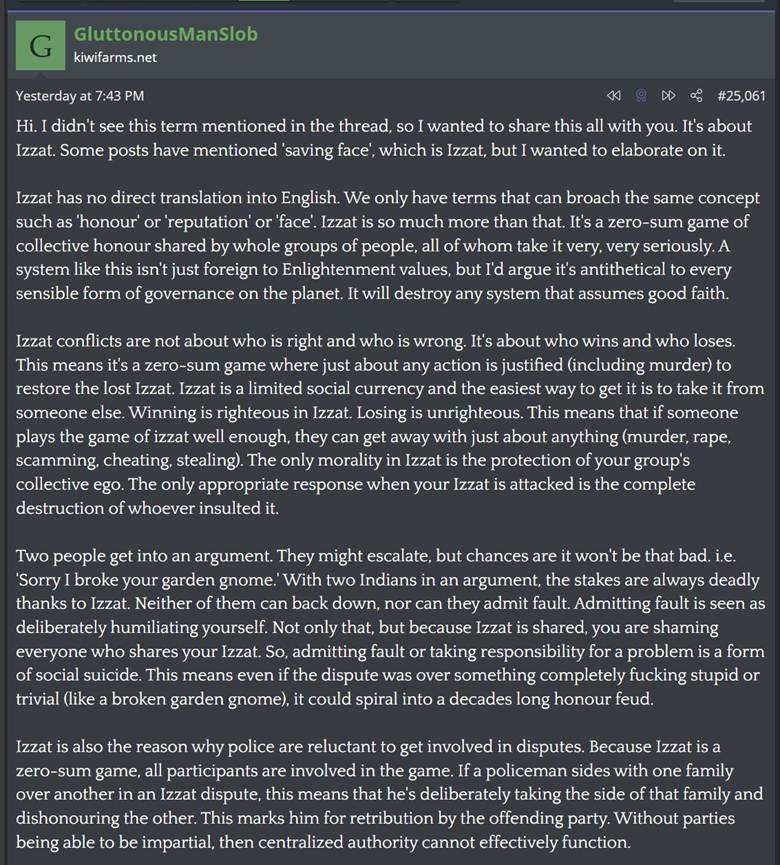

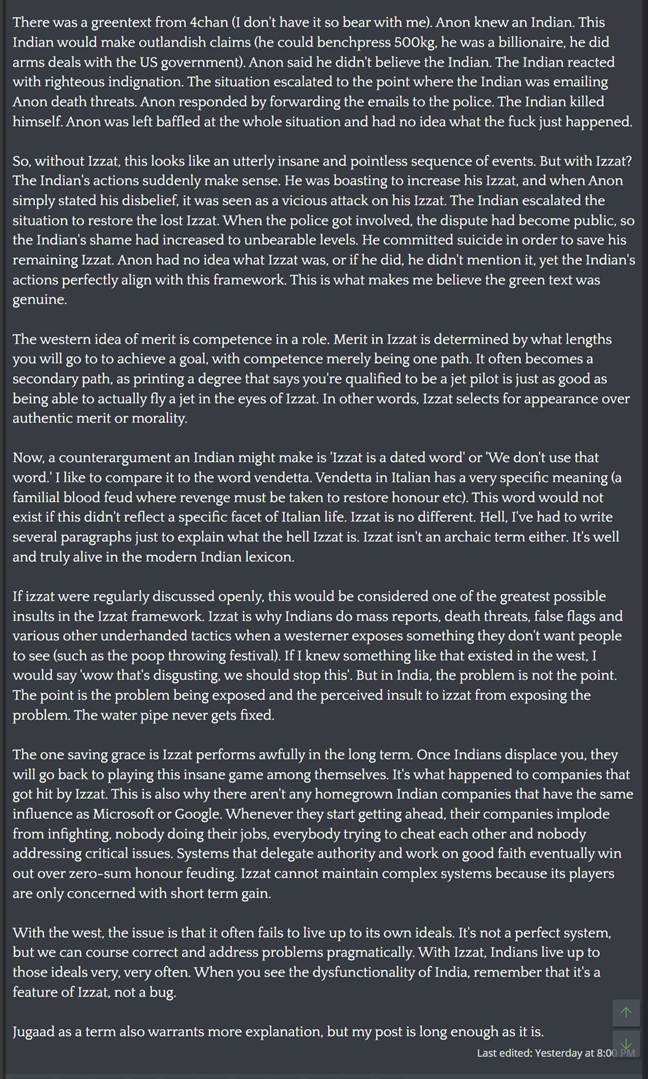
Izzat, as described, is not truly unique but is rather the Indian way of applying what is typically called “low trust” behavior or a “low trust society.” You might also have heard the low/high trust distinction described as the difference between guilt and shame-based cultures. For a guilt-based culture, doing a bad action is bad to the self. It taints the soul and may require confession and reconciliation with God as well as with the wronged party. It is an internal process. Shame, however, is external. It is something perceived between the self and others. The Christian feels guilt at having done wrong; the third-worlder feels shame at having been caught and others thinking less of him.
Think of the character Bender from Futurama saying, “I’m so embarrassed. I wish everyone else were dead!” Bender is an amoral agent who will steal when he can and only cares (in the default) about the problems others experience inasmuch as those problems will harm him or give him an opportunity to exploit the other.
Scamming is the default for many non-Western societies, which have not spent thousands of years under the moral systems of Europe and the Near East. If you encounter a merchant, it is up to you to push back on whatever he says, using whatever options you can (including threats) to get him to agree to a fair deal, and only after he fights and haggles with you will he admit you are clever for not doing what he asked at first.
Travel vlogs of India reveal a horror show for those not accustomed to the culture. Everyone, everywhere, is either trying to scam you or is trying to get you to do favors, depending on how they perceive their own status, or izzat, next to yours. The hotel you book will look nothing like what was shown; it was up to you to investigate just how honest the listing was, and if you accept one room instead of two when you arrive, that’s your own fault for being stupid and low status. If you want a refund, tough luck. Buyer beware.
If you want a fictional caricature of the low-trust culture that is nonetheless accurate when you get over your own hangups, it’s the Ferengi from Star Trek, whose first rule in their sacred text is, “Once you have their money, you never give it back.”
Growing up, I had lots of casual friends and one close friend who was Indian. They didn’t engage in this sort of behavior because they were all born in the USA and surrounded by white friends, but being second generation with many relatives still in India, their families still dealt with the old culture. They were sometimes careful about showing their success, because doing so could provoke jealousy (which would mean conflict), cause other group members to suddenly call in debts, or they would soon find a list of people requesting various favors. Success was to be revealed when it was advantageous to do so, at least when interacting with the culture. The family would buy a new car (that the white friends could look at), but they would be careful not to drive it often until there was a good and proper time to show it off. My closest Indian friend didn’t say all this directly; it was chalked up to “bad luck” in “his culture” to be open about your situation (good or bad) the way Americans were.
Low-trust societies function very differently from open, liberal ones like the United States, where honesty or at least fairness under pressure is assumed to be the default in most relationships. Like with the Indian friends and colleagues I have had in my life, izzat may be a total non-factor, or a term that is only distantly understood because they were integrated and Americanized from a young age. However, like anyone joining the American economic zone, they don’t magically drop their cultural habits and the door, and the extent to which they still interact with others from their home culture is the extent to which the culture, and its practices, will persist in the new land.
A critical mass of Indians means dealing with izzat right here in the USA, along with the low-trust behaviors that are common in the third world. Indeed, we are already dealing with these, as scam phone calls from Indian call centers have become so persistent and unrelenting that most people have abandoned the entire mode of communicating that is making phone calls. We text to warn others we are calling. We don’t answer because we know most of the time it will be a scam. And the scams work, because they target older Americans who don’t understand that there is now a low-trust intrusion into American culture. Baby Boomers grew up with salesmen who sold you good products, whose business model was finding good value for their clients. Salesmen now are more like the Indian merchant.
A modern economy runs on trust and honesty. There are costs to low-trust behavior that add up, making the entire system weaker and more expensive for everyone. Having to haggle, argue, and interrogate every stranger in order to do simple business wastes time and causes stress. Both parties are poorer if price information is obfuscated – the low-trust person engages in an attempted scam on the off-chance that it works, and they end up ahead (at least for now) either financially or in izzat. Fraud investigations cost real money. Our system has lost an entire mode of communication due to fraudsters, largely from India.
America is a very tolerant place. Americans tend to assume the best about any person they meet. And most individuals will live up to that, but quantity matters, since things like izzat are behaviors that happen within groups. Talking about the excellence of certain high-value individuals is moot, as is calling people “racist” for pointing out the realities of a culture that nobody wants to import wholesale into our society. Assimilation means adapting to our modes of behavior, our ways of thinking, not creating ethnic enclaves to exploit the morality that our ancestors spent centuries cultivating.
I am an independent artist and musician. You can get my books by joining my Patreon, and you can listen to my current music on YouTube or buy my albums at BandCamp.


This a much better recitation of the problem than the last one I read, whose conclusion was "and therefore we should never let non-whites into our country".
The problem with mass immigration isn't the "immigration" part, it's the "mass" part. A melting pot only works if the surrounding heat is enough to melt what you put into it. A drop of water will blend in, but a bucket of water destroys the whole thing.