

On Adapting the Classics
You could just make something new, you know.

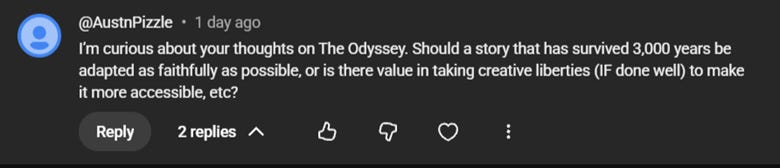
I’m curious about your thoughts on The Odyssey. Should a story that has survived 3,000 years be adapted as faithfully as possible, or is there value in taking creative liberties (IF done well) to make it more accessible, etc?
This is a great question posed to me on YouTube.
My first impulse is to say that Hollywood shouldn’t adapt anything, ever. They do a bad job of it nine times out of ten. Even the most successful adaptations (like, for example, Jurassic Park or Lord of the Rings) are watched with the general understanding that the books are much better. This isn’t helped by the fact that almost every adaptation that is financially successful subverts its source in some deep way. Even the lauded Lord of the Rings skips the real ending and turns Aragorn into a reluctant hero – a real inversion of his character and purpose in the books. The most accurate movie adaptation is probably Harry Potter, and, of course, the books are miles better if you want a great story.
The Odyssey and other classics (real classics, not merely classics of English literature) are still different from the above, which are adaptations of popular fiction novels. Homer is closer to something biblical, a foundational work of a particular people featuring characters that were real people, at least to his ancient audience. We need not dig into the morass of mythology and its purposes for this article; suffice it to say that myth and legend are different than popular fiction.
When interacting with a source like Homer, we have to ask what the purpose of it is, or what we view that work as.
Is The Odyssey a series of events, a good plot featuring relatable characters? Is it a timeless moral tale that exists to instruct us? Or is it, as I would suggest, a portal to an ancient world populated by people whose minds are often quite alien to us, but whose means (the characters, the adventures, the conflict) are closer to something universal. When we interact with the classics, we don’t just enjoy a good story (in fact, students often struggle to “enjoy the story” because of how different that story is presented compared to contemporary styles). We encounter the ancients. The poems and dramas of ancient Greece teach us about the Greeks and what they valued, what they hated, and what excited them.
From that perspective, accessibility is something quite different than if Odysseus’s journey was simply a tale to be told and by which to gain a little entertainment. This is why translations of Homer (including the one that the new movie is based on) can be controversial. Moving the poem into modern vernacular allows the common man to access the poem, but the hand of the translator is there, affecting access to that source, choosing shades of meaning. Their decisions have an impact, and we care about them because the voice of the classics is heavy with meaning.
Does making a movie out of the Odyssey make it more accessible to the modern man? I think so—and therein lies the greatest hazard, as I have spoken of before. For good or ill, the power of the audiovisual medium is astounding, and a movie is so much more viewed than a given book is read, that the default view of a work exists in the minds of most normal people as a movie. For most people, Lord of the Rings exists as they saw it on screen. Even those who have read the book frequently default to the movie’s version of events, aesthetics, and especially characters. Knowing this, making a movie out of a foundational text of civilization is actually a heavy burden.
There are old arguments which I have entertained regarding the necessity of altering a work when translating it into a new medium. A novel is different from a film, and each of them have their own strengths and their own conventions for how they communicate. But if a given work (it could be The Odyssey, or anything that isn’t a film) must be drastically changed in order to work in the new medium, why not use those resources to create an original work? Even something inspired by the source can move unshackled if it dares to be its own piece of art. Why not something like Oh Brother, Where Art Thou?
Again, we are stepping into deeper waters when we pose questions like this. Hollywood does not adapt stories because filmmakers really love them and want to do them justice (or else, why would they change so much?) but because there is a baked-in audience who will see the hype of the marketing push, a guaranteed basic return on investment. Studios are capable of making original works, but nowadays most movies are sequels, remakes, or adaptations mainly, I believe, for financial reasons.
One must also consider that adaptations, given what I have said above about movies being the default medium for remembering stories, may also be used to specifically and deliberately subvert or invert the meaning of the source because the filmmakers actually don’t like it (otherwise, again, why would they do this?). It appears from early viewings that Nolan has done this with his new movie, which seizes upon the name of Homer’s poem. We had all the signs that this would be the case. He is capable of producing original movies, as he has done many, and they have been very successful. He could do anything he wanted, and he chose to do The Odyssey, and to do it in the way that he did. For love or money, it is an act of will, and his version of the epic, his desire for what it ought to be, will become the default for the modern “normie.”
But I will leave you all with this: I encourage you all to go to the source in whatever way you can, and not just for Homer. If we refuse to attempt to read the sources, then we deserve what we get.
I am an independent artist and musician. You can get my books by joining my Patreon, and you can listen to my current music on YouTube or buy my albums at BandCamp.

